Bayesian Multilevel Model
A proper Bayesian binomial GLMM fitted with Stan via brms. Unlike the logit-normal approximation on the frequentist page, this model uses the exact binomial likelihood — sample size drives shrinkage automatically, with no ad-hoc weighting.
Why the binomial likelihood matters
The single most important modelling choice: using y_success | trials(n_trials) instead of treating raw proportions as continuous.
A school that achieves 80% with 200 students is very different from one that achieves 80% with 15 students. The Normal model (M0) treats them identically — both shrink the same amount toward the grand mean. The Binomial model (M1) knows the first estimate is reliable and barely touches it, while aggressively shrinking the second.
M0: Normal (ignores sample size)
Every school shrinks equally toward the grand mean, regardless of how many students it has. The arrows (vertical lines from the diagonal) are uniform across the colour range.
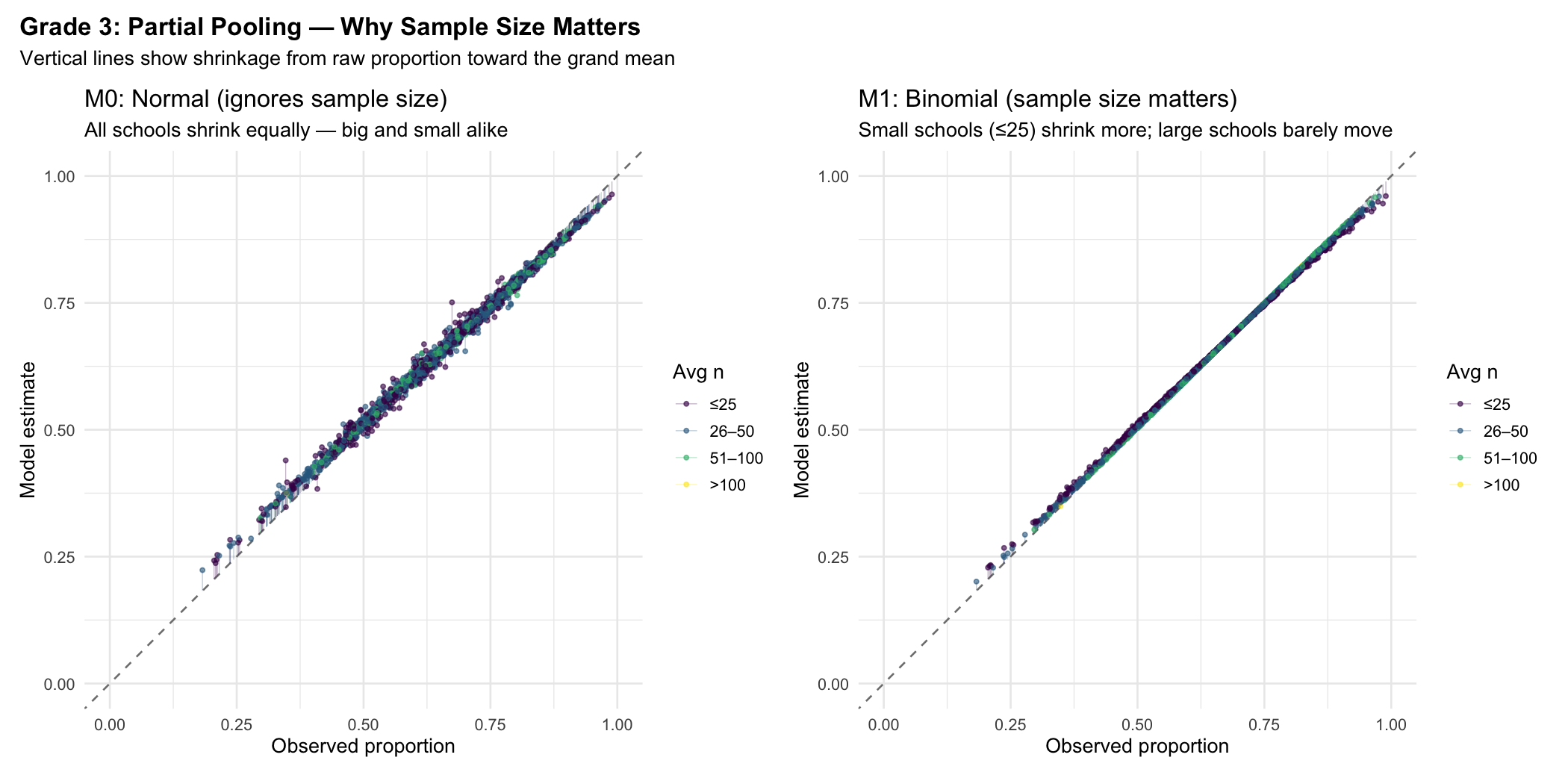
In the left panel, all schools get pulled toward the mean equally — the colour bands (sample size) don't matter. In the right panel, small schools (yellow, ≤25 students) are yanked hard toward the mean, while large schools (purple, >100) barely move. This is Gelman's partial pooling in action.
Shrinkage decreases with sample size
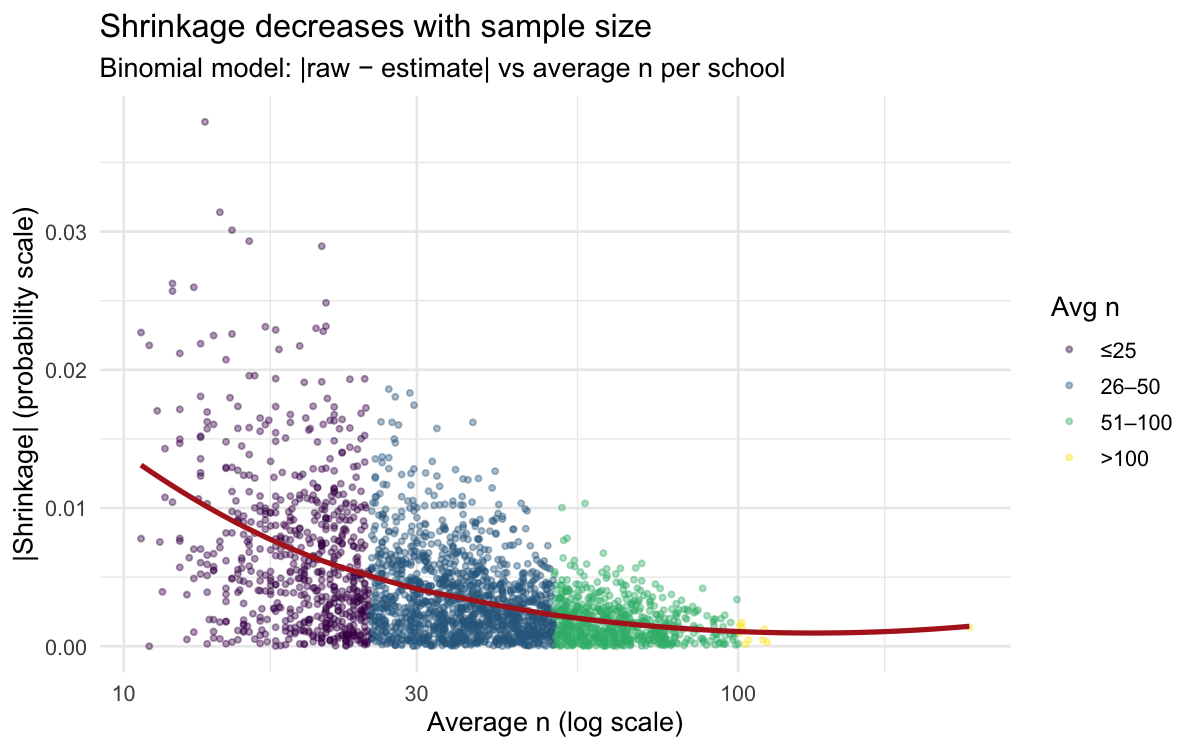
The relationship is monotone and dramatic. Schools with n > 100 barely shrink at all — their raw proportions are already reliable. Schools with n < 25 can move 10+ percentage points toward the grand mean.
Variance decomposition
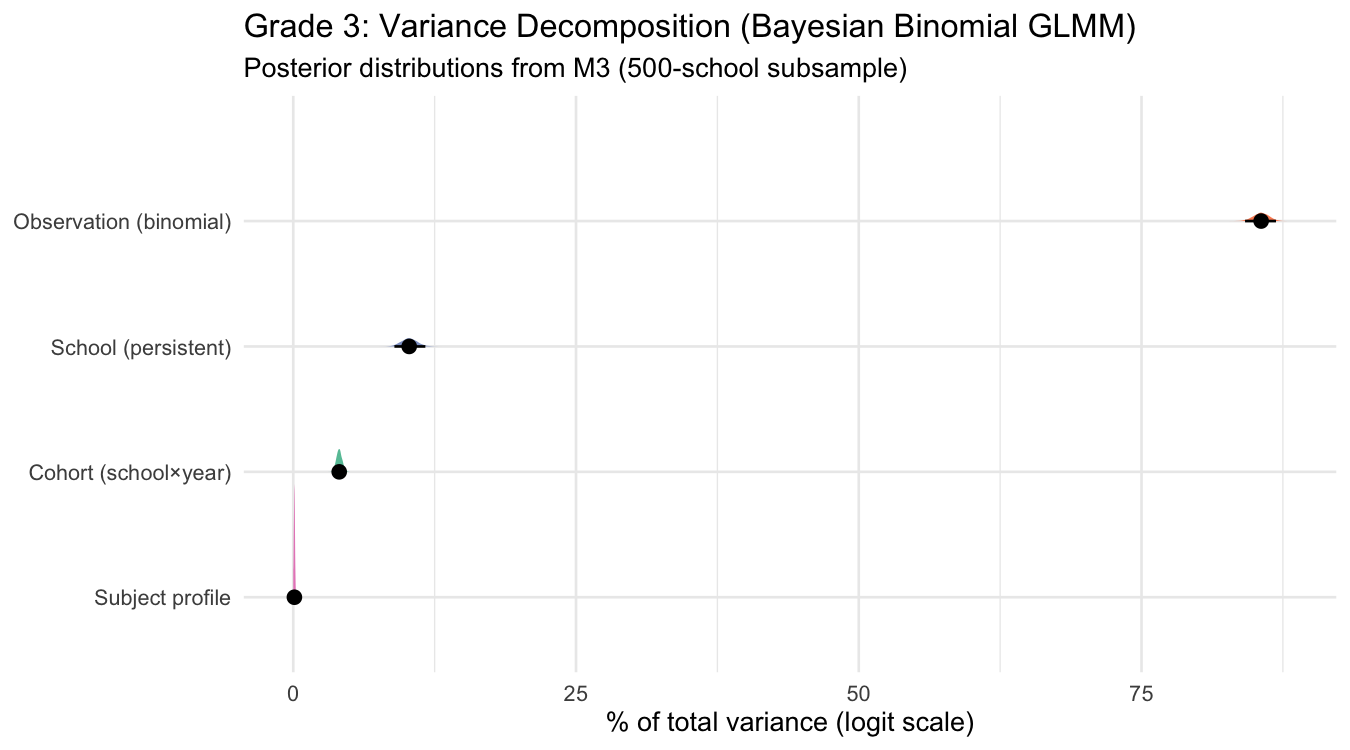
The full model (M3) decomposes variance in school×year×subject L3/L4 achievement into four sources. On the logit scale, the binomial observation-level variance (π²/3 ≈ 3.29) is a theoretical constant that dominates — so we show both the full decomposition and the latent-scale decomposition (excluding binomial noise).
Full decomposition (logit scale, including binomial noise)
| Component | Variance | % of total | Interpretation |
|---|---|---|---|
| Observation (binomial) | π²/3 = 3.29 | 85.6% | Binomial sampling noise (theoretical, not estimated) |
| School (persistent) | 0.395 [0.339, 0.455] | 10.3% [8.9%, 11.7%] | Stable school quality across years and subjects |
| Cohort (school×year) | 0.156 [0.138, 0.177] | 4.1% [3.6%, 4.6%] | Year-specific shared movement across subjects |
| Subject profile | 0.004 [0.001, 0.008] | 0.1% [0.0%, 0.2%] | School×subject divergence (e.g. strong in Math, weak in Writing) |
Latent-scale decomposition (excluding binomial noise)
Removing the theoretical π²/3 term gives a view comparable to the frequentist logit-normal approximation:
| Component | % of latent variance |
|---|---|
| School (persistent) | 71.0% [66.7%, 75.0%] |
| Cohort (school×year) | 28.2% [24.3%, 32.5%] |
| Subject profile | 0.7% [0.1%, 1.4%] |
The frequentist model on the main Multilevel Model page found: school ~57%, cohort ~21%, noise ~22%. The Bayesian model attributes more to persistent school quality and less to noise — partly because the binomial likelihood properly accounts for sampling variation that the logit-normal lumped into the residual.
- Teacher quality is transient: An exceptional Grade 3 math teacher is there for a year or two, not permanently. That signal lands in the cohort (school×year) component, not the persistent subject profile.
- ELL composition shifts all subjects: Schools with many English learners tend to score lower across reading, writing, and math — a level shift absorbed by the school intercept. A subject profile only emerges if ELL-heavy schools are systematically better at math relative to their own reading.
- L3/L4% is a coarse threshold: Subject-specific strengths may appear in mean scores or level distributions but get masked by the binary "meeting standard" cut-off.
- Grade 3 generalist teaching: Most G3 instruction comes from a single classroom teacher, limiting the scope for school-level subject specialization. The effect would likely be larger at G6 or G9.
School SD shrinks as we add structure
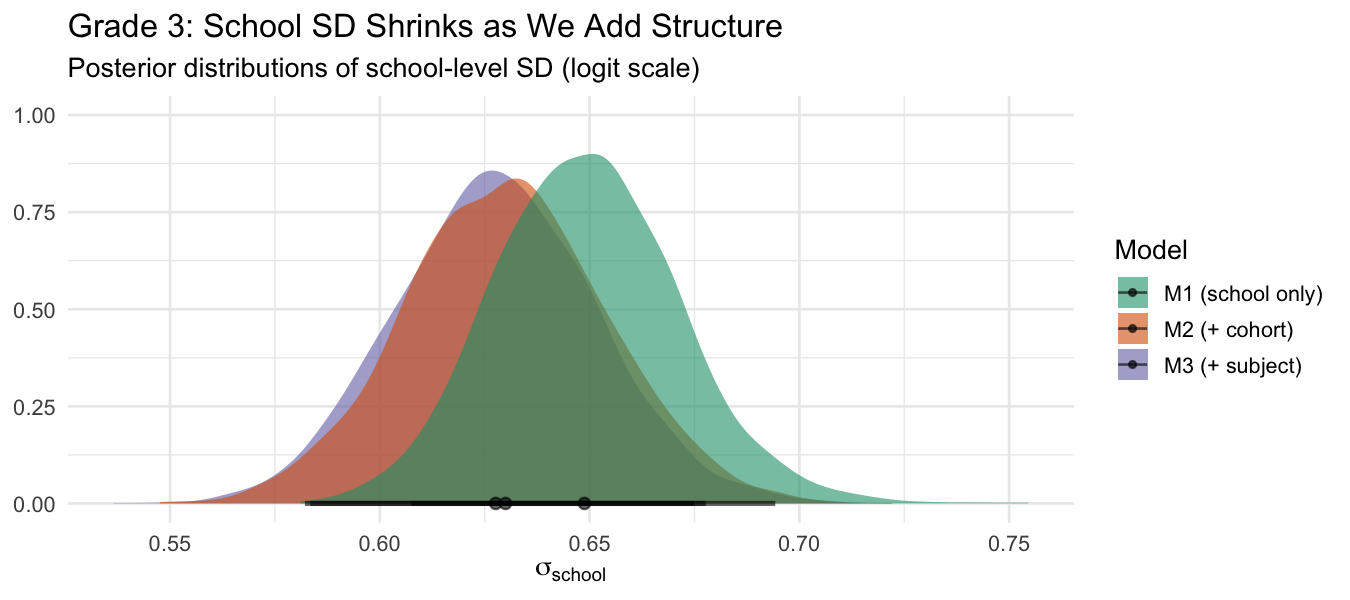
As we add random effects for cohorts and subject profiles, the school-level SD decreases. Some of what M1 attributed to "persistent school quality" was actually year-to-year cohort variation.
School random effects (caterpillar plot)
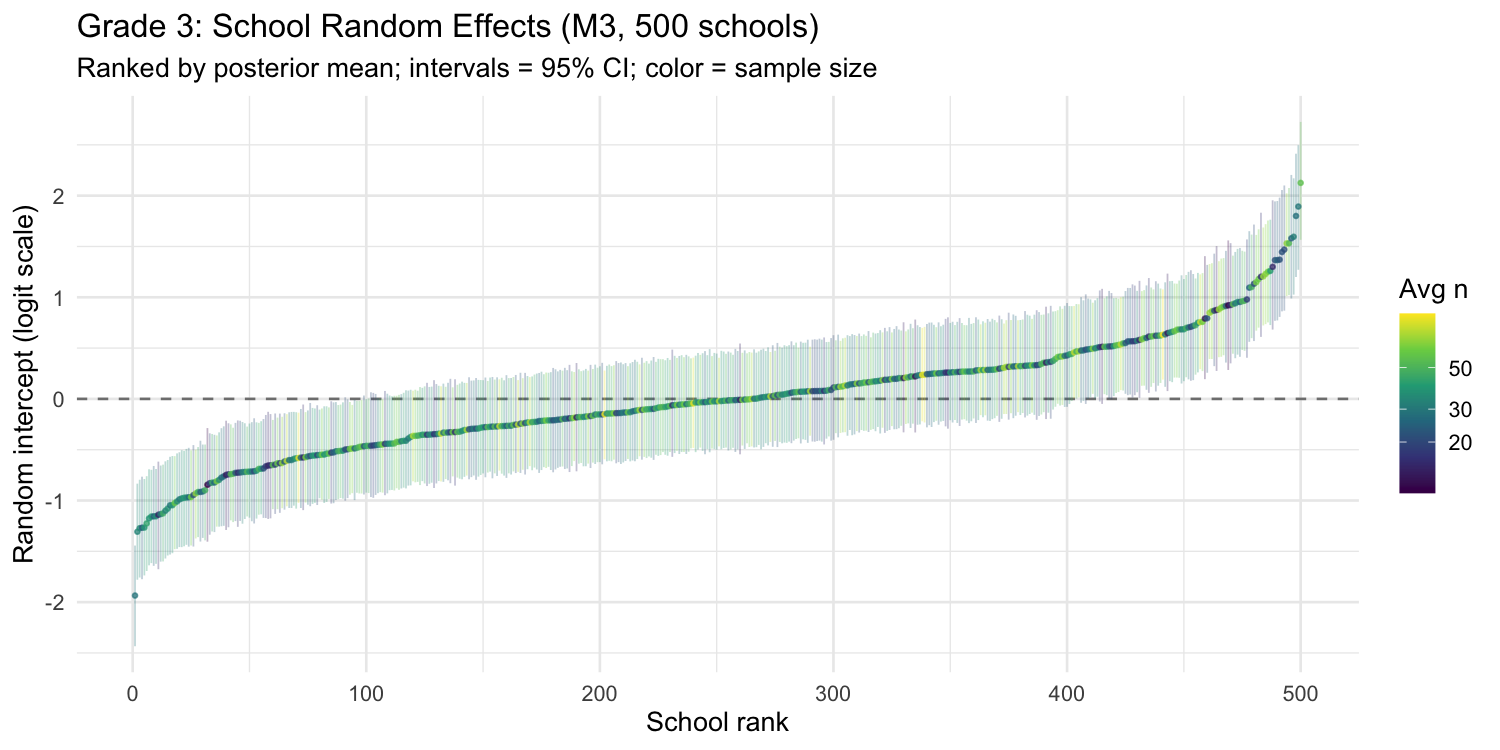
Each point is one school's posterior mean random intercept from M3, ranked from lowest to highest. The intervals are 95% credible intervals. Colour indicates average sample size — notice how small schools (yellow) have wider intervals.
Model comparison (LOO-CV)
Leave-one-out cross-validation on the 500-school subsample confirms the progressive improvement:
| Model | Description | ELPD diff | SE diff |
|---|---|---|---|
| M3 | School + Cohort + Subject | 0.0 | — |
| M2 | School + Cohort | −15.3 | 4.1 |
| M1 | School only | −2451.3 | 87.3 |
M3 (full model) wins decisively. The jump from M1 → M2 is massive (adding year×subject fixed effects and cohort random effects). The M2 → M3 improvement is smaller but significant (3.7 SE), confirming that subject profiles are a real — if modest — effect.
Stage 1 production model
The M0–M3 comparison above uses a 500-school subsample for speed. For the G3→G6 value-added pipeline, a separate Stage 1 production fit runs M2 on the full expanded sample:
- Formula:
y_success | trials(n_trials) ~ year_subject + (1 | school) + (1 | school_year_id) - Schools: 3,246 eligible G3 schools (expanded from ~2,646 by switching from a strict all-observations gate to observation-level filtering — individual observations with < 50% participation are dropped; schools need ≥ 2 observations at ≥ 70% participation)
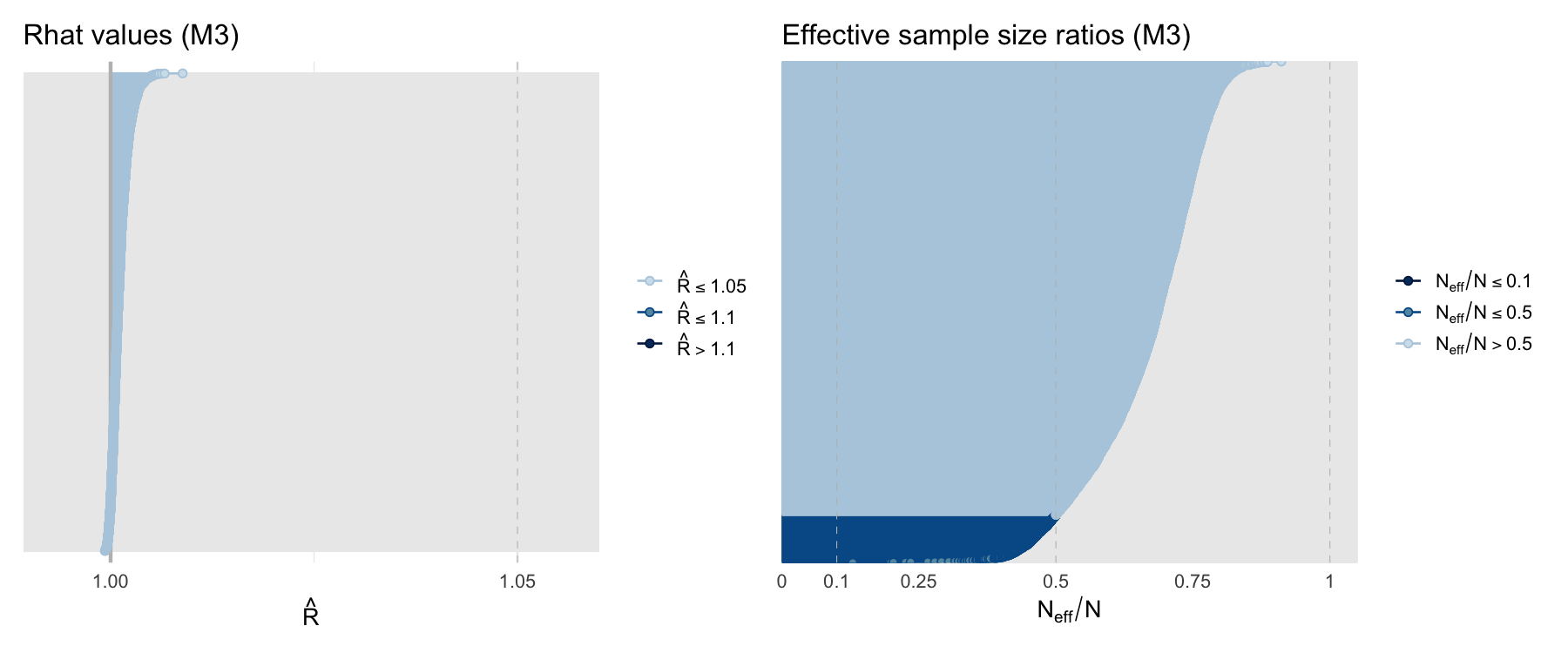
- School RE SD: 0.65 logit (posterior mean), Rhat ≈ 1.00 throughout
- Output:
g3_school_quality.parquet— one row per school with posterior mean (g3_school_re) and posterior SD (g3_re_sd) of the school random intercept
The posterior SD is carried into Stage 2 as a measurement-error input: me(g3_school_re, g3_re_sd). This corrects the attenuation bias from treating a noisy estimate as a fixed covariate — without it, the G3 coefficient is shrunk toward zero because the regressor contains estimation error. See the G3→G6 Value-Added page for Stage 2 details.
MCMC diagnostics
Trace plots
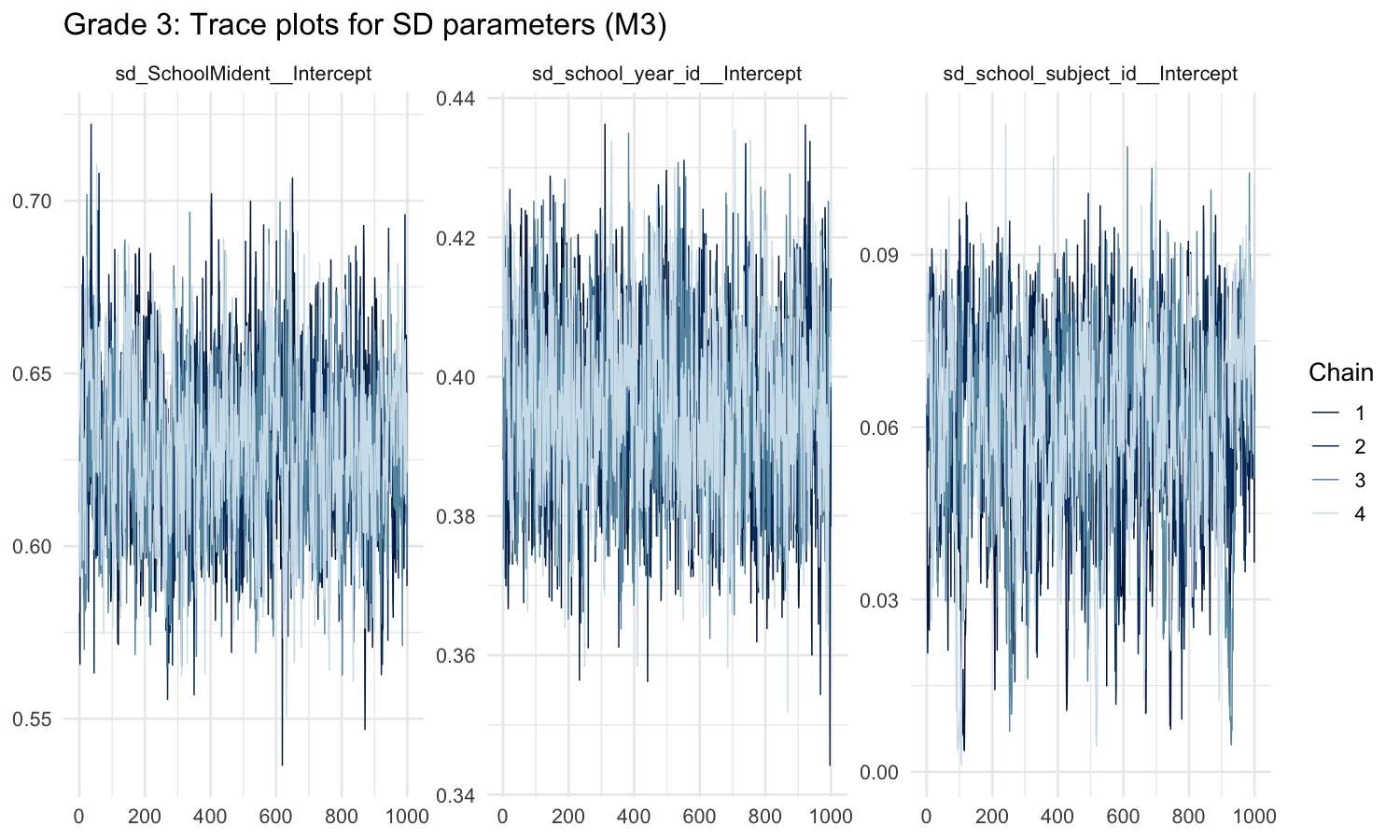
Well-mixed chains for the three SD hyperparameters. All four chains explore the same region of parameter space with no trends or sticky patches.
Convergence diagnostics
Comparison with frequentist approach
| Aspect | Frequentist (statsmodels) | Bayesian (brms/Stan) |
|---|---|---|
| Likelihood | Logit-normal approximation | Exact binomial |
| Weights | Ad-hoc n·p·(1−p) | Built into likelihood |
| Uncertainty | Point estimates + SE | Full posterior distributions |
| Variance decomposition | By subtraction across models | Direct from joint posterior |
| Shrinkage | Implicit in BLUPs | Explicit, driven by n |
| Speed | Seconds | ~20 minutes |
| Sample | All schools | M0/M1: all 3,246; M2/M3: 500 subsample; Stage 1 production M2: all 3,246 |
The two approaches broadly agree on the ranking of variance components (school >> cohort >> subject profile), but the Bayesian model is more principled about uncertainty and gives tighter school-level estimates by properly using the binomial likelihood.